


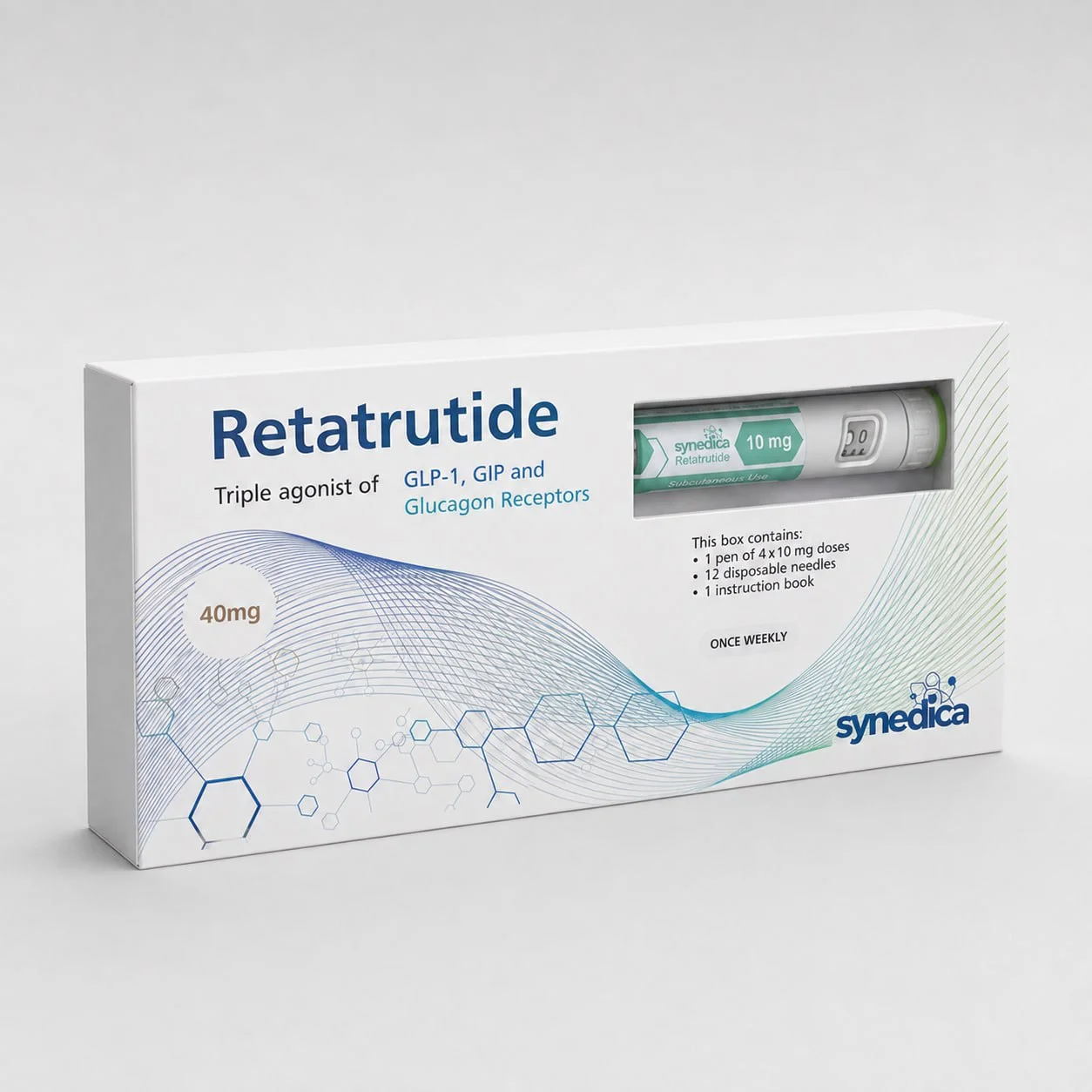
Retatrutide Pen: What the Research Actually Shows About the Triple Agonist
Here is an uncomfortable fact about the research peptide market: the certificate of analysis has become a marketing asset. Purity percentages get screenshotted, reposted, and attached to batches they do not describe. That habit is the single biggest reason researchers end up working with material they cannot vouch for.
It is also the reason this article starts with verification rather than mechanism. The retatrutide pen is now the most searched research peptide in the UK, and the volume of information available about it has outrun the volume of information that is actually checkable.
Start With What Can Be Verified about Retatrutide
Before any question about binding affinity or receptor selectivity, there is a more basic one: what is in the pen, and how do you know?
A supplier should be able to state the batch reference, the analytical method used, the laboratory that performed the work, and the date it was performed. All four, on the listing or a linked document, matched to material that physically exists.
Most listings offer one — the purity figure — and treat the other three as optional. That is backwards. A purity number without identity confirmation is a number. A purity number without a batch reference describes a batch that may have no relationship to the pen in the box.
What Retatrutide Is, and Why the Pen Format Exists
Retatrutide is a synthetic peptide built to engage three receptors: GIP, GLP-1, and glucagon. The first two are the incretin pair that made dual agonists famous. The third is where retatrutide departs from everything before it — glucagon receptor activation raises energy expenditure, moving the body’s balance toward oxidation rather than storage.
That is a mechanistic claim, and it is testable, published, and the subject of ongoing work. It is not the same as a clinical outcome, and the two should never be used interchangeably.
The pen format is a separate matter from the pharmacology. Peptides degrade. Lyophilised powder requires the end user to handle reconstitution, and every one of those handling steps introduces variance. A sealed research pen with a stated concentration and recorded storage conditions collapses those variables. That is a logistics solution, not a scientific one — but for bench work, logistics is where reproducibility is won or lost.
Where UK Researchers Source Retatrutide
The practical checklist for UK sourcing does not change much between suppliers, which is useful, because it means you can apply it consistently.
Ask what format the material is supplied in. Ask what the stated concentration is. Ask whether the certificate is batch-specific or generic. Ask what laboratory performed the analysis and when. A supplier who can answer all four without redirecting you to a generic “quality” page is a supplier worth a second look.
Material supplied in a defined format, with the specification published on the listing itself rather than buried in a downloadable PDF, removes friction. Retatrutide 40mg research pen is a working example of that — batch reference, purity, and storage conditions all recorded where a buyer can see them before ordering.
The Four Things a Retatrutide Certificate Must Tell You
Take any certificate of analysis and check it against these, in this order.
Identity. Mass spectrometry confirms the compound is what it claims to be. HPLC confirms how much of it there is. These are not interchangeable tests — HPLC separates by retention time, and a compound with a similar retention profile can inflate a purity figure. Without mass spec, purity alone proves very little.
Batch traceability. The certificate must reference a batch identifier that matches the material. Generic certificates presented as if they were batch-specific are common, and they are close to worthless.
The laboratory. Named. Not “an independent third-party lab.” A named laboratory can be checked, accredited status verified, and results queried. An unnamed one cannot.
The date. Analysis describes a batch at a moment in time. A certificate from three years ago is a historical document, not a quality assurance.
Batch-linked batch certificates of analysis that let a buyer match documentation to material are the minimum standard. Anything less is presentation.
What the Published Retatrutide Evidence Supports
The most substantial published work on retatrutide is the phase 2 dose-ranging trial in the New England Journal of Medicine, 2023. It reported dose-dependent weight reduction across cohorts, with the higher dose arms producing the largest mean changes, plus shifts in several secondary metabolic markers.
What it does not establish is long-term safety or hard outcomes. Phase 2 answers whether a signal exists and at what dose. Phase 3 answers whether that signal translates into something that matters over years. Retatrutide is firmly in the gap between those two questions.
It is also worth being precise about the setting: the trial ran in a clinical population, with pharmaceutical-grade material, defined dosing, and continuous medical supervision. That is not a description of laboratory research. They are separate activities and the distinction is not a technicality.
The Safety Reality
Retatrutide is investigational. No regulator — MHRA, EMA, or FDA — has approved it for any indication.
The published trials reported gastrointestinal events consistent with the incretin class, and the phase 2 trial recorded discontinuations. Glucagon receptor agonism adds considerations around hepatic and cardiac parameters that remain under active investigation.
Anyone describing a retatrutide pen as risk-free, or positioning themselves as qualified to advise you on its use, is not giving you a scientific position. They are giving you a sales position.
The Practical Summary of Retatrutide
Verify before you trust the mechanism. Insist on identity confirmation alongside purity, batch-linked certificates, a named laboratory, and a recent test date. Understand that the pen format solves handling variance, not pharmacological uncertainty. Read the phase 2 data for what it is: a genuine and interesting signal, in a compound that remains unapproved and incompletely characterised.
That is a more useful position than either the hype or the dismissal.
About the Author
United Peptides Research Team writes on analytical standards, batch documentation, and sourcing practice in the research peptide supply chain. United Peptides is a UK supplier of research-grade peptides. All material discussed is supplied strictly for laboratory research use only and is not intended for human consumption.
