

Humanoid robots attract investment because their shape fits places built for people. The investment case depends on whether the robot can do paid work at a cost that makes sense.
- Investors are buying a path to many tasks, not a finished worker.
- The useful proof sits in cycle time, payload, uptime, and safety records.
- A demo can start the discussion; paid operation has to support the price.
One robot, many possible jobs
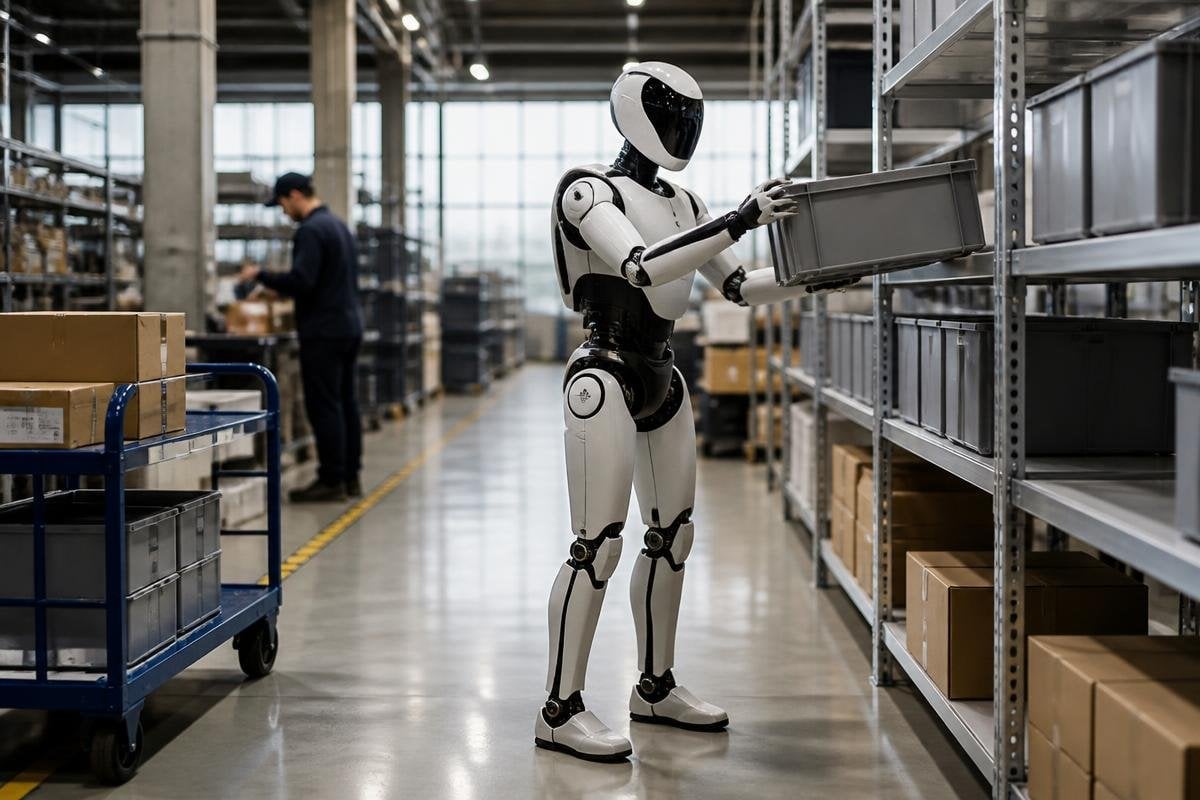
A human-shaped robot can use doors, shelves, carts, tools, and workstations made for human hands. That gives investors a broad market story: one platform could move between tasks instead of staying tied to one fixed station.
The idea has a clear limit. The robot may fit the room and still fail at the job. Its hand may lift the object but place it too slowly.
Its cameras may read a clean test area but lose track of parts under poor light. Shape helps with access; it doesn’t prove useful work.
For an investor, that makes the software and hardware plan matter. A company needs to show how the robot handles changes in object size, shelf position, floor condition, and task order. Each added task raises testing costs and can slow deployment.
Why the market case looks large
Factories, warehouses, hospitals, and other work sites already use tools, carts, and controls made around human movement. A humanoid robot could fit into those spaces without a full rebuild, if its reach, balance, and safety systems work well enough.
That possibility can support a large company value even before sales become large. Investors may be paying for future use across several work areas, while the company still has to prove one repeatable job first.
The evidence pack for this topic contains no funding totals, deal records, company names, dates, or unit counts. So the safe conclusion is about the investment logic, not a claim about which firms have invested or how much they paid.
The missing deal figures make the machine’s record the next place to look. Robot24.com’s company and machine reports can help you compare what a humanoid has shown with where it has worked, before the numbers decide the bet.
The numbers that decide the bet
Investors need figures tied to a task. A list price without work output tells little. A payload number without cycle time tells less.
Ask for the robot’s price, the cost of its gripper and sensors, and the labor needed to run it. Then compare those costs with the task’s current labor and equipment cost. The comparison needs a named site and a defined job, or it remains a pitch.
Runtime matters in the same way. Ask for operating hours, charge time, battery swap time, and the number of human supervisors needed for each robot. Frequent stops may require more staff than its sales model allows.
Safety records carry equal weight. Check how the robot detects people, what speed limits apply near workers, and what happens after a sensor fault. A machine that stops safely may still lose money if it stops too often.
What remains unproven
The hardest part is usually the handoff between tasks. Picking an object from a known bin is one job. Picking it after another item has shifted, then placing it into a moving cart, adds several failure points.
Maintenance also changes the cost. A robot with many motors, cameras, and joint sensors may need regular checks and spare parts. The buyer needs service times, repair costs, and a clear plan for failures.
Training data can create another gap. A robot may work well in the places used for training and need more work in a new site. Investors should ask how the system learns from errors, who approves new task data, and how a customer can stop a bad action.
I’d keep my money behind a company that publishes paid-site results, repair rates, and total operating cost rather than polished clips alone.
A buyer’s evidence checklist
Before an investment or purchase, ask for:
- Named work site: where the robot ran, what task it did, and for how long
- Measured output: completed cycles per hour, with the test conditions stated
- Full cost: robot, gripper, sensors, service, power, and human supervision
- Failure record: stops, dropped objects, recovery time, and repair frequency
- Safety method: detection range, stop behavior, speed limits, and approval process
- Next proof: the exact task or site planned for the next test
A humanoid robot can attract money before it earns money. The next useful proof is a dated result from a named site, with output and cost shown together; until that appears, the investment case remains a forecast.
