


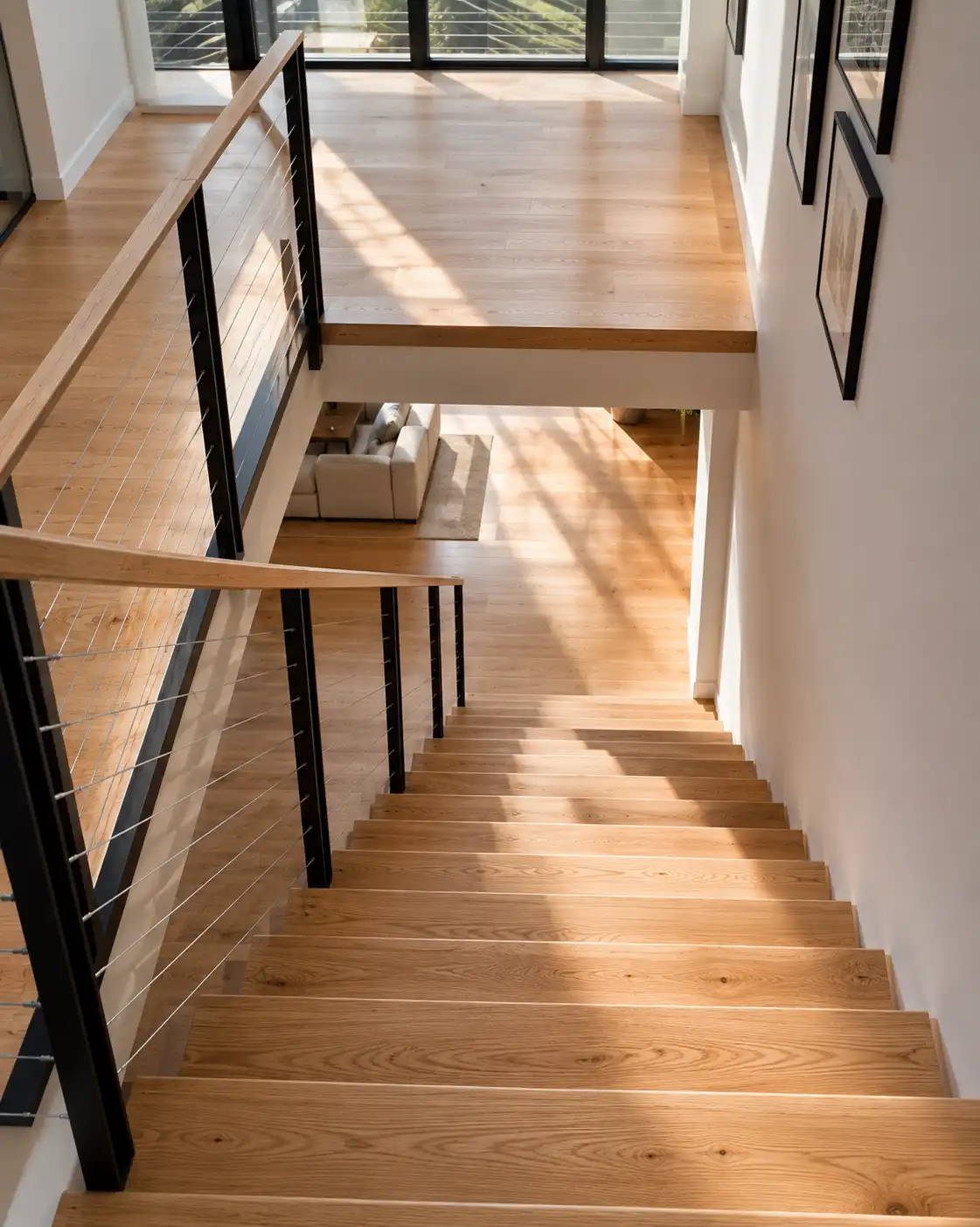
A staircase can become one of the most demanding parts of a flooring or remodeling project. Each tread must fit correctly, coordinate with the surrounding floor, and withstand daily foot traffic. Choosing prefinished stair treads can reduce onsite finishing work while giving contractors, flooring dealers, and designers greater control over the completed appearance.
What Are Prefinished Hardwood Stair Treads?
Prefinished hardwood stair treads are sanded, stained, and coated before they arrive at the project site. Depending on the order, they may be produced in a selected wood species, color, sheen, width, depth, and nosing profile.
This differs from unfinished treads, which require sanding, staining, coating, drying, and sometimes additional touch-ups after installation. Site finishing can be suitable for certain projects, but it adds several steps that must be considered when preparing the schedule and labor estimate.
Prefinished components shift much of this work away from the property. Installers can focus on fitting and securing the stair parts instead of managing a separate finishing process inside an occupied or nearly completed building.
How Does Prefinishing Reduce Onsite Work?
Finishing hardwood inside a home creates practical challenges. The contractor needs space for sanding equipment, stain, finish products, and application supplies. Dust must be controlled, nearby surfaces need protection, and occupants may have limited access to the stairs while coatings dry.
Prefinished treads arrive ready for installation. Although cutting, fitting, adhesive application, and fastening still require care, the contractor does not need to complete the full staining and coating process onsite.
This can help reduce:
- Sanding dust inside the property
- Exposure to stain and finish odors
- Drying time between finish coats
- Restrictions on staircase use
- Labor devoted to onsite coating
- Weather-related finishing concerns
Reducing these variables can be particularly valuable in occupied-home renovations, where homeowners want to limit disruption and regain access to the staircase as quickly as the installation allows.
Why Does a Controlled Finish Matter?
Wood finishing is affected by preparation, application technique, temperature, humidity, drying conditions, and the natural characteristics of the lumber. Completing the process in a controlled production setting makes these conditions easier to manage.
Factory finishing can also provide greater consistency across several related stair components. Treads, risers, landings, and trim can be prepared as part of the same order, helping the visible parts of the staircase share a coordinated appearance.
Natural wood will still display variations in grain and color. These differences are part of the material rather than defects. Contractors and dealers should explain this before the order is placed, especially when the client expects every board to look identical.
Can Prefinished Treads Help Keep Projects on Schedule?
Onsite finishing adds several schedule dependencies. Sanding must be completed before staining, stain must dry before the protective coating is applied, and each coating may require additional curing time. Humidity or low temperatures can extend this process.
Prefinished treads remove many of these dependencies from the installation schedule. Contractors can plan around delivery and installation instead of coordinating several finishing visits.
This does not mean every prefinished project will be faster. Accurate measurements, material availability, production time, acclimation requirements, and installation conditions still affect the timeline. However, fewer onsite finishing stages can make the schedule easier to estimate and communicate.
What Should Professionals Confirm Before Ordering?
Accurate specifications are essential. A small measurement or material error can delay installation and increase costs. Before placing an order, confirm:
- Stair width and tread depth
- Quantity of straight, return, and landing components
- Left-hand or right-hand return requirements
- Wood species and grade
- Nosing profile
- Stain color and sheen
- Existing flooring thickness
- Substrate and installation method
- Lead time and delivery requirements
For renovation projects, contractors should also inspect the existing staircase before finalizing the order. Older stairs may have inconsistent dimensions, damaged framing, or construction details that are not apparent from initial photographs.
Templates or individually recorded measurements may be necessary when the staircase is not uniform.
How Can Stair Treads Coordinate With Hardwood Flooring?
A staircase often connects two floors, which makes it a visible transition between flooring surfaces. The tread color does not always need to be identical to the floor, but the species, undertone, grain, and sheen should feel intentional together.
Physical samples provide a more dependable basis for color comparison than phone or computer images. Screens, cameras, and room lighting can change how a stain appears. When a close match is important, several flooring samples may be needed to account for natural board variation.
Designers and contractors should also review the staircase under the lighting used in the home. Daylight, warm bulbs, and cool bulbs can each affect the perceived color.
How Should Dealers Set Customer Expectations?
Flooring dealers are often the connection between the customer, installer, and stair-part supplier. Clear communication at the ordering stage can prevent misunderstandings later.
Customers should understand that hardwood is a natural material. Grain patterns, mineral streaks, and subtle color differences may appear across the treads. Samples indicate the general finish direction but cannot predict every characteristic of the finished wood.
It is also important to distinguish between coordinating and duplicating. New stair parts can be made to coordinate closely with an existing floor, but age, sunlight, previous coatings, and normal wear may affect the floor’s current color.
Prefinished stair components can reduce jobsite disruption, simplify scheduling, and help create a coordinated staircase. Flooring dealers, contractors, builders, architects, and designers can visit Wood Stair Co to review hardwood stair options and discuss the requirements for an upcoming residential or commercial project.
